
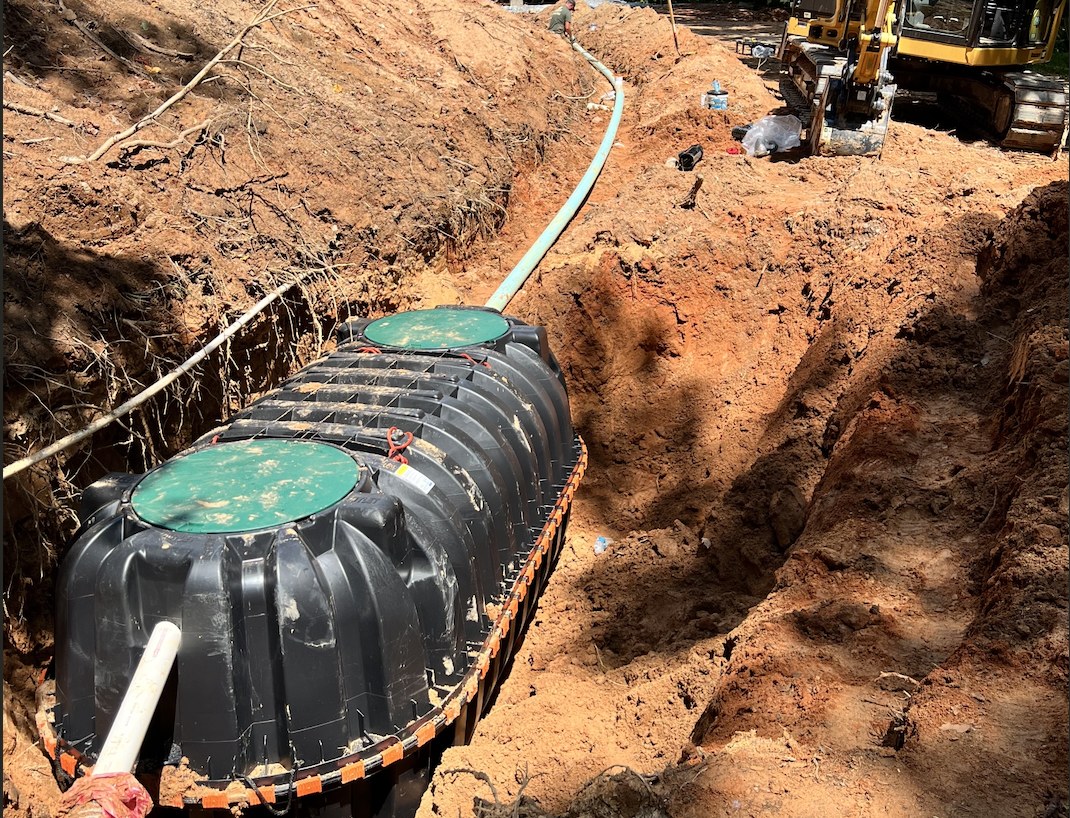
If you're building a home on land without public sewer anywhere in Greenville, Spartanburg, Anderson or Pickens County, the septic permit comes first. Without it, the county won't issue your building permit (SCDES).
Septic permits in South Carolina are handled by the South Carolina Department of Environmental Services (SCDES), which took over this program from SC DHEC. Here's how the process works, what you'll need to do to get your lot ready, and where a site contractor fits in.
Before anything else, call your county or local water and sewer provider and ask if public sewer is available to the property. SCDES won't issue an onsite wastewater permit where public sewer is accessible (SCDES). If you're still shopping for land, ask this before you buy.
The application is the Onsite Wastewater System Application (form D-1740), submitted online through the SCDES ePermitting portal. You'll need a copy of the property's plat or deed, and the application fee is $150 (SCDES).
SCDES reviews the paperwork first. If something is missing, you'll get an email explaining what to fix and resubmit.
Be honest about the number of bedrooms. SCDES sizes the system by bedroom count, at 120 gallons per day per bedroom, so a typical three-bedroom home is sized for about 360 gallons a day (SCDES). Underestimating bedrooms to fit a smaller lot sets the system up to fail.
This is the step that holds a lot of people up. Under Regulation 61-56, before the site evaluation you're required to (SCDES, R.61-56):
The regulation also says you may be required to clear underbrush so the inspector can do the evaluation. If your lot is grown up in brush and young pines, that's where land clearing or forestry mulching comes in. On a homesite, stumps also have to come out in the footprint of the house and yard, so plan the clearing with the final layout in mind.
Here's the part that's specific to our area. All four Upstate counties sit above the South Carolina Fall Line, in the Piedmont. SCDES says sites above the Fall Line require backhoe pits for the soil evaluation, because inspectors are likely to hit rock with a hand auger. You, the applicant, are responsible for getting an operator to dig the pits, and they have to be dug according to the SCDES soil evaluation guidelines (SCDES). You can confirm your site's location on the SCDES GIS map linked from that page.
Once your application is in, an SCDES inspector will contact you to schedule the site and soil evaluation. Have your operator lined up so the pits are open when the inspector arrives.
During the evaluation, the inspector takes at least two soil samples where the system will most likely go and looks at (SCDES):
SCDES is clear that finding suitable soil for the septic system takes priority over where you'd like the house and outbuildings. Bad soil can even limit how many bedrooms you can build.
Weather matters too. If the soil is too wet, SCDES may not be able to evaluate it until it dries out, which adds time to your permit (SCDES). With winter rains coming, it's worth getting your application and site prep done early.
If the site works for a conventional system, SCDES issues a Permit to Construct. It's good for five years. If you need to change it, or renew it after five years, that takes a new application and a new fee (SCDES).
If the site doesn't pass for a conventional system, the inspector will talk through alternatives. At that point you'll need a Professional Soil Classifier (PSC). You can also hire a PSC up front to do the soil evaluation and submit the report with your application, which SCDES says should shorten processing time. PSCs are licensed by SC LLR (SCDES). Subdivisions of 10 or more lots must use a PSC.
With the Permit to Construct in hand, you hire a licensed onsite wastewater system installer. Before the system is covered, the installer schedules an SCDES inspection. If the inspector doesn't arrive within 30 minutes of the scheduled time, a licensed installer can do a self-inspection and document it on SCDES form D-4432 (SCDES), which must be submitted within two business days (SCDES forms). Once the system meets state standards, SCDES issues an Approval to Operate (SCDES).
Renew Land Management is a licensed septic installer, and we also do the clearing, grading and utility work around it. That means one crew can clear the lot, dig the evaluation pits, install the system, and grade the site afterward, without waiting on another contractor's schedule. See our septic services and utilities and drainage pages for more.
Ready to start? Get a Free Quote and we'll come walk your lot.
No. SCDES says it hasn't used perc tests since the late 1970s because they aren't accurate. A site can pass in a dry season and fail in a wet one. Today the inspector evaluates soil color, texture and the site itself (SCDES).
The Upstate is above the South Carolina Fall Line, where rock makes hand augers unreliable. SCDES requires backhoe pits for soil evaluations above the Fall Line, and the applicant is responsible for having them dug.
Five years. Renewing it or changing it requires a new application and fee.
Not always. The septic system needs suitable soil, setbacks and a repair area, and SCDES says that takes priority over where the house and outbuildings go. Get the soil evaluated before you finalize your house plan.
Renew Land Management handles land clearing, grading, drainage, utilities and septic work across the Upstate, with one crew from start to finish.
Get a Free Quote


